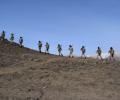
The 60-metre bridge is around four kilometres east of the confluence of Shyok and Galwan rivers, and links the narrow mountainous region to the Shyok-Daulat Beg Oldi road.

In recent years, China and Russia have pushed for de-dollarisation within BRICS, which India has resisted. One reason is that India does not want to hurt its relationship with the United States, and another is the fear of China controlling trade because the renminbi is considered the strongest currency in the bloc today.

'The Chinese military cannot advance much in Ladakh, even if they want to.' 'Similarly, in Arunachal Pradesh, they can rename a village or two, intrude here or there, but cannot do much more realistically.'

India and China are in what experts call 'a cooperation-versus-competition situation'.

The jawan, Sachin More, was a native of Malegaon in Nashik district, around 200 km from Mumbai.

India and China held constructive talks on the situation along the Line of Actual Control (LAC) in eastern Ladakh, emphasising that maintaining border peace and tranquillity enabled progress in normalising overall relations.
'We won not (only) because we were able to carry out long-range precision strikes.' 'That is, of course, one of the reasons but we had better situational awareness about what's happening than Pakistan.'
The army refused to disclose the information saying it was third party information which cannot be shared under Section 8(1)(j) of the Act, which exempts from disclosure the information which is personal in nature.
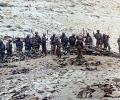
At least 38 PLA troops drowned while crossing a fast-flowing, sub-zero river in darkness, according to an article in the Australian newspaper The Klaxon which cited a report prepared by a group of social media researchers after a year-long investigation.

The fierce battles of Galwan, Rezang La, Gurung Hill, and Walong taught the PLA a hard lesson: Fighting the Indian Army would never be easy or inexpensive.
A total of around 100 troops took part in the operations from the Indian side while the Chinese had over 350 people on the location.

The T-72 tank with five soldiers on board sank due to flash floods while they were crossing the river.

The Galwan clashes indicate to the limitations in relations if they do not address border stability, points out Srikanth Kondapalli.
The Galwan clashes indicate to the limitations in relations if they do not address border stability, points out Srikanth Kondapalli.
The Indian Army has been slow to react. Indian troops have deployed in the vicinity of PLA incursions, but there are no attempts to outflank Chinese positions.

Chinese Foreign Minister Wang Yi's visit to India focuses on border talks with NSA Ajit Doval, amidst efforts to rebuild relations after the Galwan Valley clashes and rising India-US tensions.
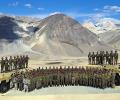
If China is accommodating regarding Depsang and Demchok, a resolution of the Sino-India territorial dispute in Eastern Ladakh could be possible.

Over 68,000 Army soldiers, around 90 tanks and other weapon systems were airlifted by the Indian Air Force to eastern Ladakh from across the country for rapid deployment along the Line of Actual Control (LAC) after the deadly clashes in the Galwan Valley, top sources in defence and security establishment said.
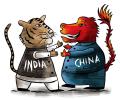
India and China have announced a series of measures aimed at improving their relationship, including maintaining peace along the border, reopening border trade, and resuming direct flights.
Within the army, there is growing concern that New Delhi will allow the Chinese to retain the territory they have occupied in the last month.

India on Thursday announced that its charge d'affaires in the Beijing embassy will not attend the opening or closing ceremony of the 2022 Winter Olympics in the Chinese capital over China honouring a military commander involved in the Galwan Valley clashes as its torchbearer for the mega sporting event.
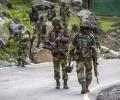
The sources said there was clear sign of withdrawal of structures and troops from the patrolling point 14 in Galwan Valley and that they are likely to move back more than a kilometre in the area.

It took India and the Indian Army to show to the world that enough is enough and to challenge the neighbourhood bully, he said.
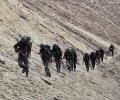
The government needs to answer the critical question of whether it has accepted any restrictions on its infrastructure creation activities, asserts Ajai Shukla.
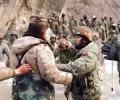
Indian military sources said no firearms were used in the clashes and that most of the injuries were sustained following stone-pelting and use of rods by the Chinese side.

Senior officers recounted extreme Chinese brutality to the Indian prisoners, with some of them being pushed over cliffs and soldiers' bodies being recovered from the Galwan River.

India and China should build on 'good progress' in normalising the bilateral ties to address border-related issues including de-escalation, and it is essential to avoid 'restrictive trade measures and roadblocks', External Affairs Minister S Jaishankar said on Monday during talks with his Chinese counterpart Wang Yi.

Four Chinese soldiers were killed in the fierce clash with the Indian Army in the Galwan Valley in eastern Ladakh in June last year, the People's Liberation Army (PLA) acknowledged for the first time on Friday.
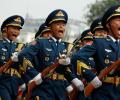
Since the June 15 clash, the PLA has inducted large numbers of troops, armoured vehicles and artillery along the LAC, from Depsang and Galwan in northern Ladakh to Hot Springs, Pangong Tso, and Chushul in central Ladakh, to Demchok and Chumar in southern Ladakh.
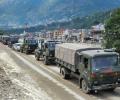
Indian Army planners find themselves contemplating the possibility of more Chinese intrusions along the contested 3,488-km border. That could lead to the army having to man a 'hardened LAC' round the year, like the LoC with Pakistan, reports Ajai Shukla.

India and China have agreed to rebuild ties and resume people-to-people exchanges, including resuming direct flights and the Kailash Manasarovar Yatra this year. The two countries also discussed the resumption of dialogue mechanisms to address each other's concerns and move relations to a more stable path. The meeting comes after a period of strained relations following the Galwan Valley clashes in 2020.

'The Chinese staying put in Pangong Tso, and creating a buffer zone on Indian territory in other areas,' a senior serving general tells Ajai Shukla.

With the two armies again in a face-off at multiple points, there is apprehension of renewed clashes.

China remains in firm control of an estimated 600-800 square kilometres of Indian territory.
Some may see China's decision to antagonise India as strategically unwise. But China believes its prestige demands standing up to India, whatever the cost.

China has chosen to keep New Delhi guessing, while retaining for itself the option of constantly changing facts on the ground and shifting the LAC westwards -- the strategy called 'salami slicing', notes Ajai Shukla.

'The intentions are clear as day! Let India build the infrastructure, then they will claim the land and use the infrastructure to their benefit.' Air Commodore Nitin Sathe (retd) speaks to IAF veterans who have flown in the Galwan Valley long before it became today's headlines.

The Indian Army started bringing the T-90 Bhishma and T-72 Ajay tanks along with the BMP series Infantry Combat Vehicles from the deserts and plains in a big way to these high altitude locations from last year with the beginning of the Operation Snow Leopard to counter the Chinese aggression in eastern Ladakh last summer.

In underlining the role of border villages as custodians of India's frontiers, New Delhi is following China's example in Tibet.
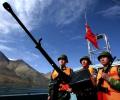
Both the Indian and Chinese armies have brought in more troops in sensitive locations like Demchok, Daulat Beg Oldie and areas around Galwan river as well as Pangong Tso lake in Ladakh, the sources said. The area around Galwan has been a point of friction between the two sides for over six decades.
